By Sevril Health Team · · 3 min read
A definition worth being precise about
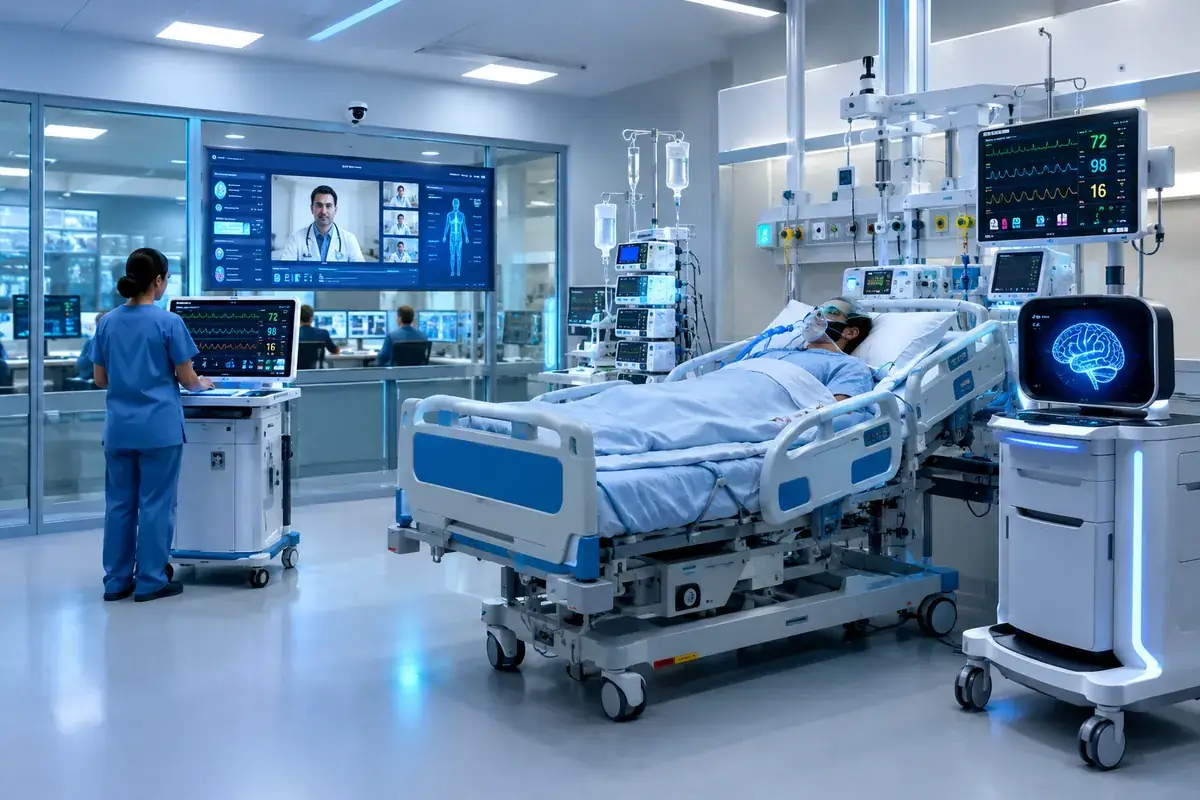
A Smart ICU, also called tele-ICU or tele-critical care, is an intensive care unit that is permanently connected to a team of intensivists and critical-care nurses who are not standing in the room. Continuous vitals, live audio-video and a shared record let that remote team work with the doctors and nurses at the bedside, not in place of them.
The premise is simple. The sickest patients in a hospital should not depend on whether a specialist happens to be in the building at 3 a.m.
Five moving parts
- The bedside link. Existing monitors and a bedside terminal send heart rate, SpO2 and respiratory rate to the command centre securely and continuously.
- The watch floor. Remote clinicians follow every connected bed from a single dashboard, paying attention to trends as much as to thresholds.
- The alert path. When a value crosses a limit, nurse and doctor phones are notified, and the alert follows a defined route: acknowledge, assess, escalate.
- The live consult. An intensivist can join the bedside over audio-video, review the patient with the team and agree the next step.
- The shared record. Observations and advice are documented, so the next shift inherits the reasoning as well as the result.
What a Smart ICU is not
It is not a substitute for bedside clinicians. Your team still examines the patient, performs procedures and delivers treatment. The remote team contributes a second, always-awake set of expert eyes and a consistent way of thinking about deterioration.
Who gains the most
- Hospitals that cannot roster an intensivist on every shift, particularly overnight and at weekends
- Regional hospitals that want specialist-grade critical care close to home
- Units adding ICU beds faster than they can add specialists
- Hospital groups that want one clinical standard across several sites
What has to be true on day one
- Bedside monitors that can be connected to the platform
- Dependable internet and power backup at the ICU
- A bedside terminal at each connected bed, installed and calibrated
- Trained nursing staff and agreed escalation protocols
With Sevril Health's Smart ICU, terminal installation and calibration, staff training and 24x7 technical and clinical support are part of every deployment.
Does it work?
Published studies of tele-ICU programmes (see what the research shows) report lower mortality or shorter stays in some settings and little measurable change in others. The pattern that emerges is that results follow implementation: clear escalation rules, trained staff, and trust between the remote and bedside teams matter as much as the hardware. A good partner therefore stays with the hospital after go-live, not only until the equipment is installed.
Wondering how this would work in your unit?
Tell us how your ICU is monitored today. We will explain which beds could be connected first, what the bedside terminal adds and what your nurses would do differently on day one.
Request a callback Call +91 92882 14479